Celia Hart's blog about what's going on in and around her studio. Art, printmaking, inspirations, gardening, vegetables, hens, landscapes, wild flowers, East Anglia, adventure, travel.
Not quite the traditional Easter image . . . but the forecast was spot on! This was the under-gardeners house seen through a blizzard on Easter Sunday morning!!!
Safely protected from the English spring weather (in our bedroom) we have a small lemon tree. On Saturday we harvested our first ripe lemon . . .
. . . and used it to make a Lemon Drizzle Cake for Easter Sunday tea time.
A posy of spring flowers and eggs from our four hens - perfect for Easter.
I usually like to enjoy spring flowers by walking around the garden in the sunshine – this Easter weekend the forecast is for cold wind and sleet and snow! So I braved the chill wind and rain and hunted round the garden for flowers to pick for the house. This posy vase is just right for displaying tiny spring flowers, it's one of my auction buys (I love bidding at auctions) and was made by Poole Pottery in the mid-1930s. The decoration on it is by Truda Carter, who deserves to be more widely known for her vibrant designs for Poole Pottery.
A year ago we collected our new hens from Hens4Homes, we selected four lovely 'point-of-lay' birds with slightly different feather colouring and drove home with them in a cardboard box on the back seat of the car. Since then they have supplied us (and family, friends and neighbours) with the most delicious eggs – in return they collect donations for EACH.
Kirsty at Hens4Homes correctly predicted that the darker of the Maran Cuivre birds would be 'head girl' because she was tallest and would have the largest comb. This would make her most resemble a cockerel and in the absence of a man to take charge, one of the hens would take on this role. Hens in large commercial flocks don't form heirachial groups –- they keep their heads down, avoid eye-contact with others and get on with what they have to do (a bit like commuters on the London Underground). But hens are still jungle fowl at heart, so when they are in a small group and allowed to behave naturally they instinctively sort out the 'pecking order' – and that's exactly what it is . . .
It's a bit like that classic comedy gem The Class Sketch from The Frost Report. But as long as they stick to the rules no-one gets hurt and a token peck is all that's needed for Ruby to remind the others that she is in charge. I'll let the under-gardeners demonstrate . . .
A year ago I wrote the first posting on my new blog Purple Podded Peas. I had no preconceptions, I was just curious about how blogs worked and as I like the idea of a diary but have never kept one going for more than a week, maybe this would be good way of recording work in progress in my studio and garden.
I didn't realise how enjoyable it was going to be! I love reading all your comments, thank you for taking the time. The most stylish Oscar acceptance speeches are short – so I'll just say "Here's to the next year of blogging!" . . .
In the greenhouse the Purple Podded Peas are growing. This year not only the home saved seeds of Pea 'Purple Podded', but three other purple podded varieties: 'Victorian Purple Podded', my choice from this year's Heritage Seed Library catalogue. 'Carruthers' Purple Podded', an Irish pea with beautiful flowers was a seed swap from Rebsie of Daughter of the Soil who also sent me another Irish purple podded pea, 'Clarke's Belthony Blue'. I was thrilled when Rebsie offered to swap some her her amazing pea varieties, the one I had my eye on was the 'Salmon Flowered Pea', I sowed them yesterday in a pot in the greenhouse. Yes there's more (for those who thought peas came in three varieties – frozen, tinned and mushy – this obsession with peas will seem close to madness) 'Golden Sweet' is alleged to be one of the peas used by the pioneer of plant genetics Gregor Mendal, I grew it in 2006 and it didn't do well, in 2007 I found one little plant growing among the Broad Beans, the seeds I sowed yesterday were from that plant. And – 'Carouby de Mausanne', if you only grow one pea try this French mange tout, definely the best I've ever grown.
This is the first of a new series of digital illustrations that I'm working on, The Heritage Vegetable Collection from Magic Cochin, cards and prints will be for sale on my stall at the Reach Arts & Crafts Fair on Saturday 5th April.
In the days before I owned a digital camera, I enjoyed collecting my holiday photos and spending a few evenings sticking them in an album along with tickets, menus and maps. But now my photos are digital I sometimes burn a DVD or save a selection onto a memory stick to show a slide show on a digital photo-frame, but I missed sorting through all the ephemeral bits and pieces and telling the story of our adventures.
After our recent weekend in Carcassonne I decided to make a miniature album using this beautifully hand-bound journal that I bought from Gina of Fan My Flame. I printed contact sheets of all the holiday photos and chopped up tickets and leaflets.
The other day I checked to see if there were any special exhibitions at the Fitzwilliam Museum in Cambridge, as I'd have time to visit on Sunday afternoon. This is what I found . . .
French Tapestry and Illustration For this exhibition, a highly significant bequest of eight French 20th century Aubusson tapestries is linked with a gift from the Walter Strachan Archive. Strachan (1903-1994) was a teacher, translator, poet, Francophile and promoter of the arts, known especially as the "defender in England of the livre d’artiste".
Now, I think the person who wrote that isn't gifted at marketing. In fact it's not exactly clear what the exhibition is of! But this photo looked intriguing so this afternoon I went along . . .
The exhibition is tucked away in the Octagon, a little gallery upstairs in the museum and it's a real gem! There was no catalogue, so I scribbled notes in the back of my diary . . . Walter Strachan (1903-1994) was a teacher of modern languages at Bishop's Stortford College from 1928 to 1947. He was also a gifted translator of European poetry. In 1945 he saw an exhibition in Paris of Livres d'Artistes and began a collection of limited edition artist's books created by some of Europe's most talented comtemporary artists. He became a friend to many of the artists and his collection includes hand printed New Year cards, letters and menus.
In 2007 Walter Strachan's archive was donated to the Fitzwilliam Museum, and this little exhibition shows a selection of the Livres d'Artistes and other illustrated items accompanied by letters and notes between the artists and Walter Strachan. Many of the artists also designed tapestries woven in Aubusson, France, and this exhibition shows eight beautiful tapestry panels. It's frustrating that I can't find more images to link to, but these were my favourites . . .
Jean Lurcat (1892-1966) Herbe Bleue is his beautiful butterfly design I've shown above. His illustrations depict an array of wild and fanciful beasts! If I'm ever near Angers I'll definitely find time to visit the Musee Jean Lurcat.
Simon Chaye (b. 1930) Eclosion is a design of birds in the branches of a pussy willow in shades of yellow ochre reds and black – I think this was my favourite in the exhibition. I loved how the areas between the branches were woven in different shades of ochre, giving the the design depth.
Marc Saint-Saens (1903-1973) A pair of tapestries depicting night and day, the Le Jour design includes a little bird perched on one of the rays from the sun! (A larger more complex example of Saint-Saens work can be seen here)
Dom Robert (1907-1997) Coq une de mai is a joyful design of a beady eyed black cockerel in a field of wild flowers. (I've found a very similar image here)
What an unexpected inspiring interlude! I celebrated by popping into Fitzbillies to buy a Chelsea bun. While I was waiting in the queue I read the framed 'thank you' letters in the window . . .
"thank you from my tummy"Stephen Fry
"I'll have three of everything"Professor Stephen Hawkings
(It's is a very very special cake shop!)
. . . and a new pair of Think! shoes from that lovely shoe shop – Sundaes in Green Street.
Standing on the skyline above the town of Carcassonne in south-west France is La Cité – 52 towers and 3km of battlements surround a castle, a basilica and a maze of narrow streets. This is where we've spent the weekend (our treat to celebrate our 15th wedding anniversary).
Between the two concentric walls are the Lists, where knights once rehearsed for battle!
High up on the ramparts we looked out over the vinyards of Languedoc to the Montagne Noire in the distance. If you've read Labyrinth by Kate Mosse you can pretend to be Alais, daughter of Raymond-Roger Trencavel the lord of the Château Comtal in the 12th century.
. . . we couldn't resist buying fruit jelly and nougat from this exquisite shop near the Basilica St-Nazaire!
Limoux On Saturday we took the train to Limoux, a small town on the River Aude south of Carcassonne. Limoux's claim to fame is a carnival which takes place on the thirteen weekends leading up to Easter, an uninterupted tradition since medieval times! We weren't quite sure what to expect and when we walked into town across the 400 year old bridge over the Aude all seemed quiet. Nearing the town centre we could hear music, and in the the small market square the morning session of the carnival was getting underway.
Two bands and their accompanying performers, depicting scenes from local and international news, were making their way around the arcades round the square visiting each café and bar in turn. The repetitive folk music and simple dance was infectious, onlookers jigged along with the rythm and rushed too and fro across the square as the bands took turns to perform.
The whole performance lasted over two hours! Afterwards everyone dispersed as if nothing had happened! We followed a sign to La Goutine, a small vegetarian restaurant (the only one in the Languedoc!) and had a delicious selection of vegetable dishes for lunch. After a walk along the river and looking round an exhibition about the Fecas, we returned to the square for the late afternoon performance - there was a building sense of excitement as the locals gathered with children in costume holding long wands and bags of confetti. Apparently the Fecas was a carnival of the millers of the area and they threw flour everywhere - today confetti is thrown instead.
The musicians started up and the dancers dressed as pierrots swayed and waved their long wands, in a correographed movement they dipped into their sacks of confetti and showered the crowd in white and yellow paper! The carnival party-goers and children ran to join the performers as they emerged from each café and continued round the square.
Castelnaudary On Sunday afternoon we went by train to Castelnaudary. The line followed parallel with the Canal du Midi, an amazing example of 17th century civil engineering which joins the Atlantic coast to the Mediterranean Sea. The deep oval locks and elegant bridges are marvels of construction and between them the tree lined canal snakes between the vinyards.
This is the flight of four locks leading up to Castelnaudary . . .
. . . and at the top the canal opens into the Grand Basin, a reservoir which feeds the locks. I once went with friends on a boating holiday on the Canal du Midi and remembered the thrill of the boat rising out of the last lock and this scene revealing itself in the dazzling sunshine – on Sunday the view was a just as I remembered.
Paul Klee's famously described his work as "taking a line for a walk", this was the favourite phrase of one one of my art school teachers and although we sighed because we'd heard it time and time again it is a pretty accurate way to describe drawing.
Yesterday evening I went along to a meeting of the West Suffolk Embroiderers' Guild – I'd been asked to teach them to draw (in an hour and a half!!!!). I came up with a list of quick taster exercises intended to make you think and look rather than worry about the actual drawing . . . • drawing everyday objects from memory • drawing without taking the pen off the paper • dividing a photo into simple shapes • analysing the colours in a picture • using a frame to select a composition.
Henri Matisse said "Creation is the artist's true function. But it would be a mistake to ascribe creative power to an inborn talent. Creation begins with vision. The artist has to look at everything as though seeing it for the first time, like a child. "
Over the past week the nights have been extremely cold (-5 and colder) but the days have been gloriously sunny. In our greenhouse which has a little frost-free fan heater, the max-min thermometer registers a range from +35C to +3, that's pretty challenging if you're a plant!
Here is a round-up of garden highlights during our 'extreme-February' . . .
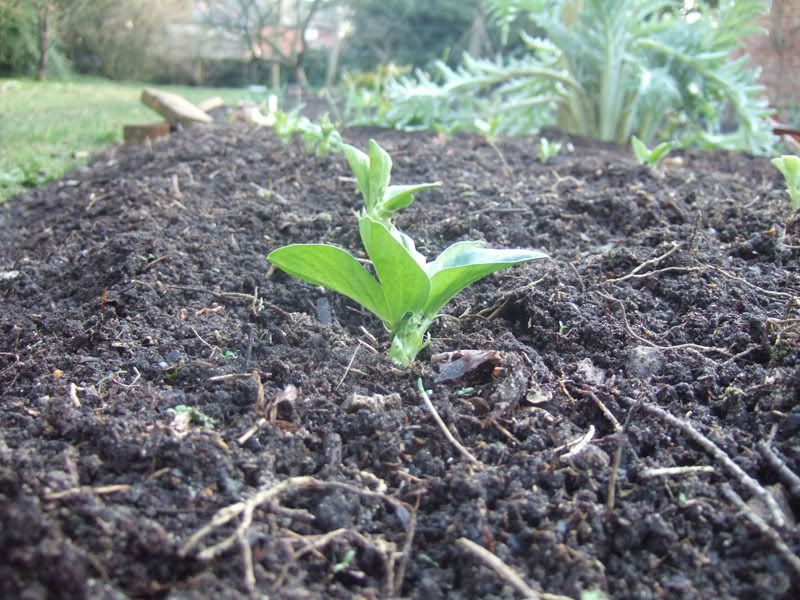
'Bunyard's Exhibition' Broad Beans sown direct outdoors on 21st November last year, are now growing strongly.
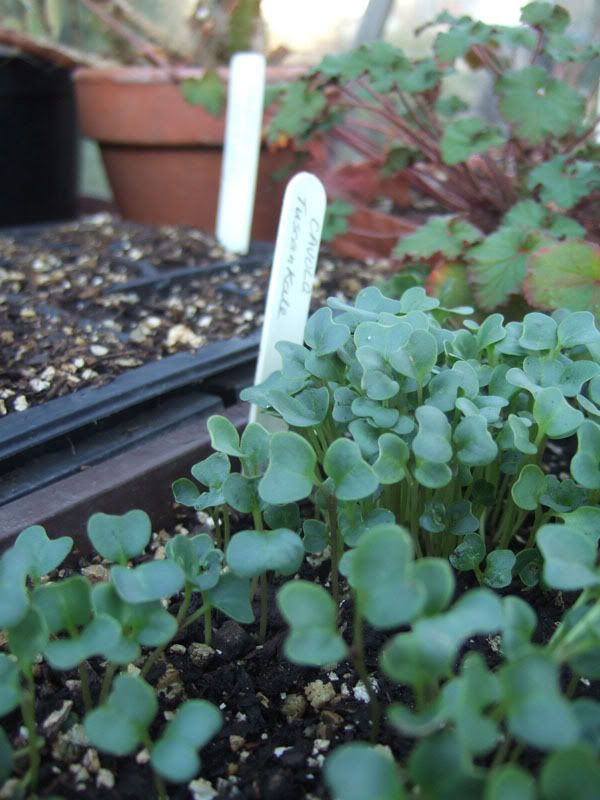
These Tuscan Kale seedlings germintated in a large heated propogator, they are now on the greenhouse shelf where they get lots of light. I'll prick out some to grow on in the vegetable garden and use the rest as micro-greens.
I am recording all the vegetables I am growing this year and their progress here.
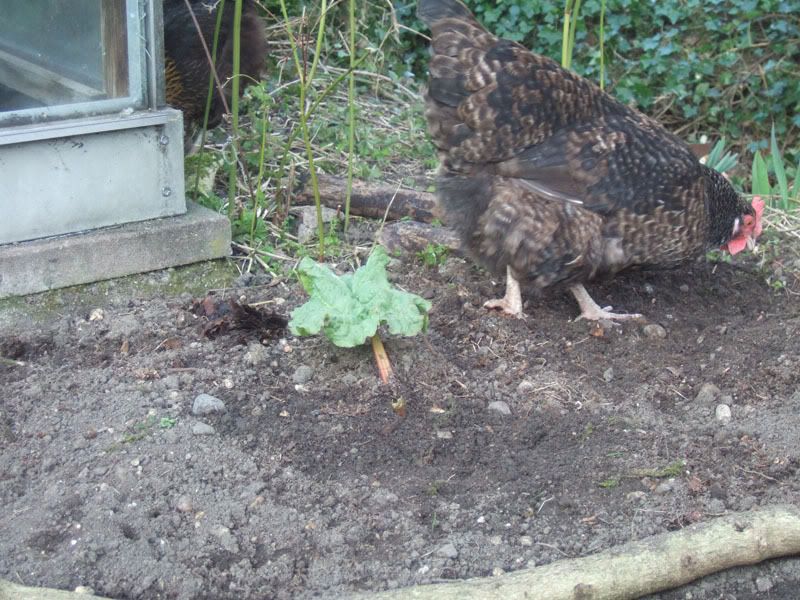
Last year's un-naturally wet summer resulted in the 'Timperly Early' rhubarb plant rotting away completely. So I have bought a new rhubarb, 'Victoria', and it's planted in a new corner bed next to the greenhouse door. The under-gardeners enjoyed helping to dig out the new rhubarb bed and mix in the well rotted compost. I'm looking forward to picking home-grown rhubarb again (maybe not until next year) and I'll definitely be trying some of the delicious rhubarb recipes tested by Freddie on the Great Big Vegetable Challenge.
And here are some of my favourite things . . .
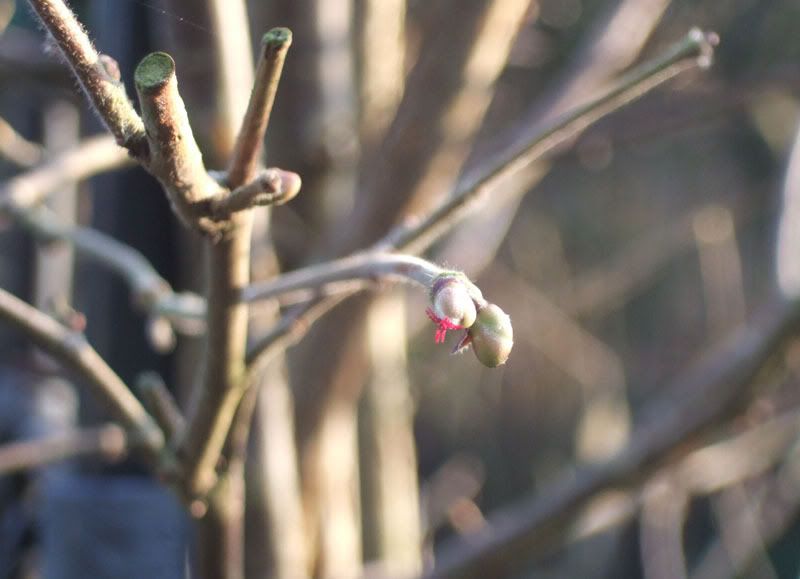
A tiny red flower on the 'Kentish Cob' equals a promise of nuts in autumn.
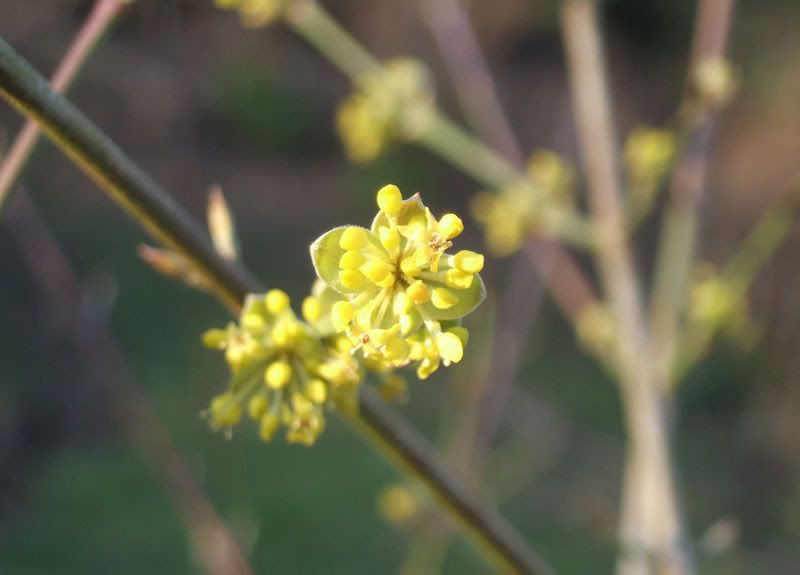
Cornelian Cherry flowers (cornus mas), perfect spring sun-bursts.
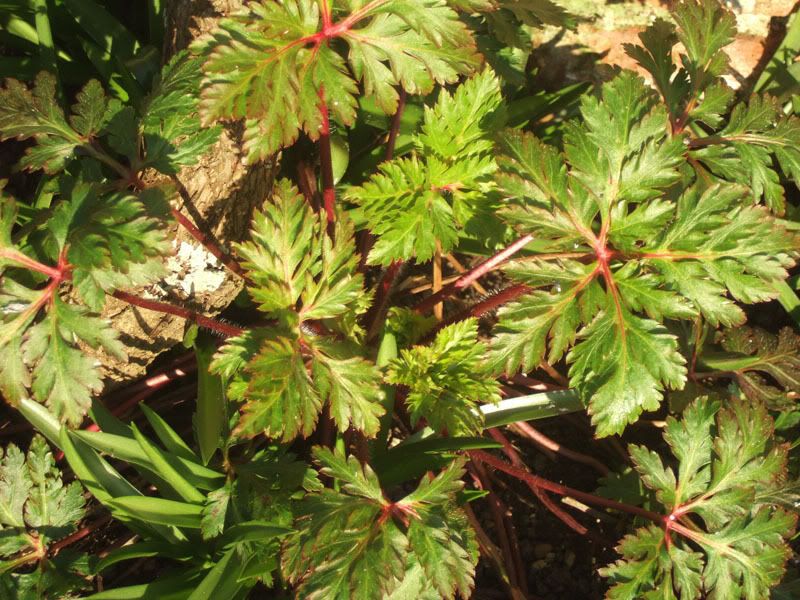
A rosette of beautiful green and red finely cut leaves of geranium rubescens, this is a well behaved biennial geranium from Madiera. It's like a giant Herb Robert and self seeds in dry sheltered corners, the bright pink flowers held on giant branching red stems will mingle perfectly with other plants. I love this plant!
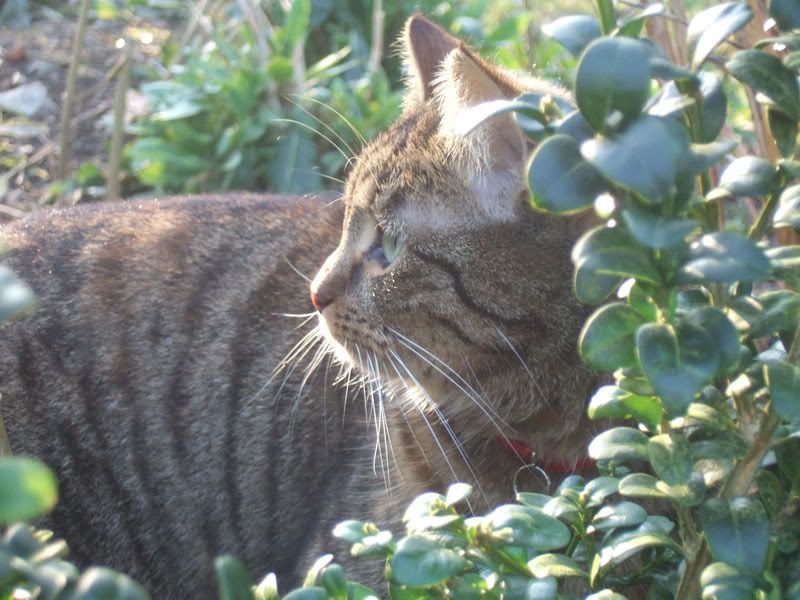
Wild-thing Chloe (studio and garden assistant) loves bouncing over and around the box hedging!
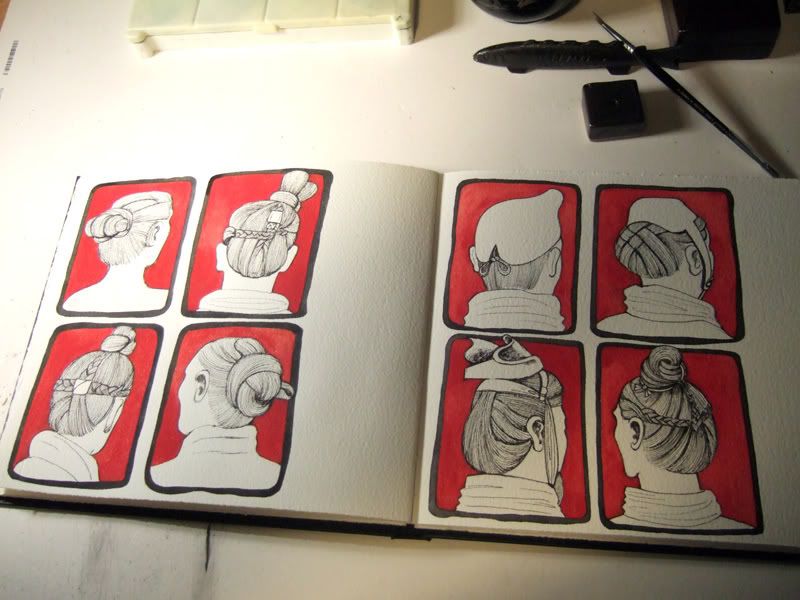
I've been reading the catalogue of The First Emperor exhibition which we visited last weekend. While at the exhibition I was fascinated by the beautifully detailed sculpted hairstyles of the terracotta warriors and wanted to know more about how they were made. It seems that the heads were made in moulds (a bit like chocolate Easter eggs) and then customised with hair styles and hats. The whole terracotta warrior making process was a well organised production line, with teams of workers specialising in just one stage – the person who 'did' braided hair must have been a real perfectionist! I would have loved to spend a few days in the exhibition with my sketch book and a comfy seat, but sadly that wasn't possible, I had to be content with the photos in the catalogue as reference for my sketchbook studies of the warriors' braided hairstyles.
A Chinese pottery production line was the subject of a recent Radio 4 programme in which the artist and 'Spitting Image' satirist and now potter,Roger Law spent time working in Jingdezhen – the porcelain capital of China. He explained that each stage of the process of making a beautiful pot was carried out by a family run workshop who had specialised in that stage of the production process for generations – so if one of the links in the chain were to disappear, the skills learnt over generations would be lost forever.
The celandine flowers are shining like miniature suns . . . bees are buzzing . . . Brimstone butterflies are out and about . . . yesterday was just perfect for some serious gardening . . .
Last year we read about some of the Chinese terracotta warriors coming to London for an exhibition in the British Museum. We watched a TV programme about the British Museum's historic circular Reading Room being transformed into an exhibition space, "We must go to see it!" we said. At Christmas we looked at the British Museum web site to book our tickets, online, "Which day shall I book for?" I said, then I looked at the calendar on the screen, colour coded for when tickets were still available – there was one ticket left for a Thursday afternoon in March!!!! . . . but (the web site helpfully explains) some tickets are available on the day if you queue up outside before opening time.
Yesterday morning we set the alarm for 5am and set off to catch the 6am train into London, it was icy cold and the sky was crystal clear with twinkling stars – did we really want to see The First Emperor so much? At 7.45am we joined a queue of about 40 people at the back of the British Museum and at 9am we had our tickets for entry into the exhibition at 10am.
Qin Shihuangdi was on a mission to crontrol all he surveyed, he inscribed his name on the mountains, he moved thousands of people into his new city, he sent out people to search for medicines to prolong his life . . . then in 210BC he suddenly died, he was 49. The elaborate recreation of his empire that was to be his home after death wasn't complete, but the ruler of the Qin was laid to rest in his tomb surrounded by his creation. The Emperor's burial mound was a well known landmark near the town of Xi'an but the Emperor's underworld was a long forgotten secret until 1974, when a farmer unearthed a terracotta head – the first of thousands of life-size statues of warriors, bureaucrats, acrobats, musicians, horses and birds that had been buried under the fields for over two thousand years.
Well, it was worth getting up before dawn to get our tickets – so many beautifully crafted things – the terracotta warriors with their intricately braided hairstyles and a poised bronze crane catching a fish were the highlights for me. And as for the enormous task of creating a world for the Emperor after his death, it defies the imagination – if these are just the guardians of the tomb, what about the tomb under the burial mound? Well that's being left alone until a method of "seeing" inside without the need to destroy the mound is developed.
Here are some rather smaller terracotta warriors made by school children who have visited the exhibition – aren't they brilliant!!
And these amazing patterns are reflections on the surface of a shiny steel statue by a Chinese sculptor (I forgot to note down the name) who apparently moulds metal around boulders to create the shapes. It stands in the covered court and is reflecting the blue sky through the glass roof.
It was just before midday when we emerged from the British Museum into the glorious sunshine. We sauntered down through Soho and had lunch at Ramen Seto, an unpretentious Japanese restaurant in Kingly Street just behind Liberty's - how convenient, we just had to go in to admire all the gorgeous things!
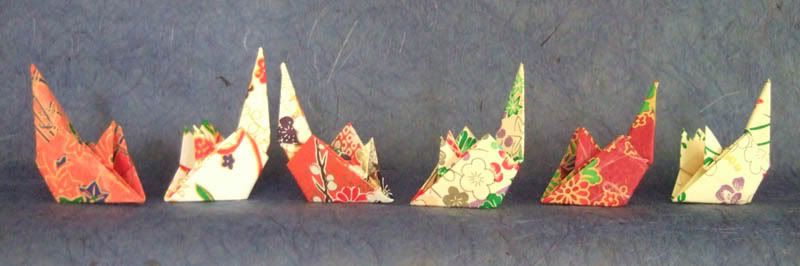
Happy Chinese New Year! It's 4706 and the start of the year of the rat, the first creature in the 12 year lunar cycle. When I first found out I was born in the year of the rat it was, to be frank, a big disappointment – a dragon, tiger or hare please, I don't want to be a scavenging rodent spreading fleas and living in sewers! I was obviously brain-washed at junior school by having to learn by heart long tracts of "The Pied Piper of Hamelin", I had nightmares about those rats! No, we're talking rats with a positive spin – the rat that got pole position in the zodiac hitched a lift on the ox's back and then, with the chequered flag in sight, jump down and skipped over the line whooping "I won!!!!" I suppose that's similar to the igenuity needed to work out how to gnaw through a wall to get to the under-gardeners' layers pellets. So in honour of the lateral thinking rodent I made six little origami rats using some beautiful Japanese washi paper.
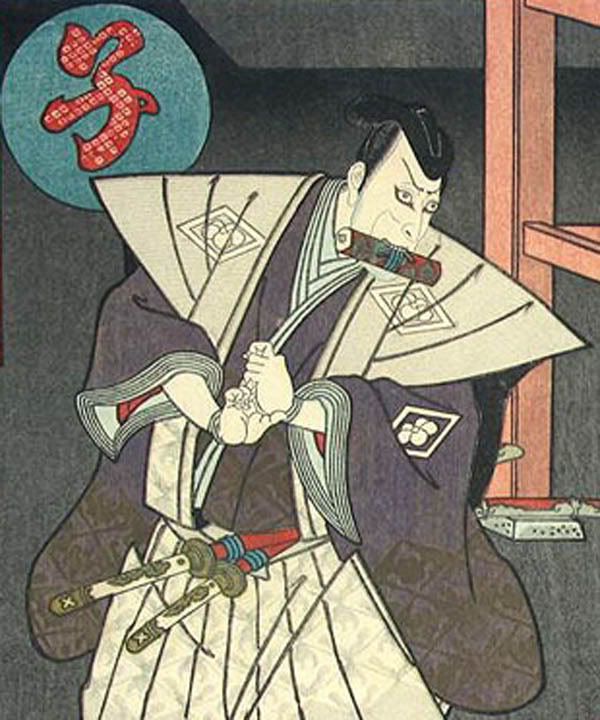
The animals selected by the Buddha to represent the 12 lunar years are a popular subject for Japanese printmakers. A couple of years ago I bought a print at a local auction and discovered that it is one of a set 12 designs by Hirosada depicting each animal of the zodiac. I wondered what Hirosada's 'rat' picture was like. It seems that recently a complete set of Hirosada's 12 prints has been sold, and they are described in detail here. Hirosada's 'rat' is actually the actor Nakamura Utaemon IV playing Nikki Danjô – a character who has supernatural powers and can disguise himself as a giant rat. It's obviously an Oscar-winning interpretation of rattiness!
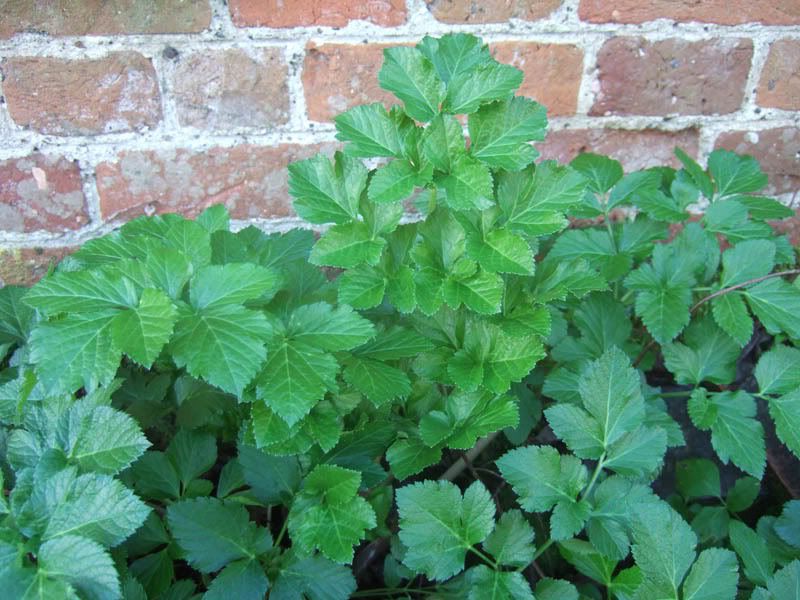
Sheltered against the garden wall is a patch of the greeniest green leaves - almost luminous in intensity, they glow green! They are the leaves of Alexanders, smyrnium olusatrum - if your botanical latin (greek?) is pretty hot then you will have already worked out that it's a culinary herb that smells of myrrh and has black seeds. The English name Alexanders gives us another clue - it originates from Alexandria, or thereabouts, and was brought to England by the Romans. Whether they actually brought along neat little packages of seed to sow in their newly built villa's vegetable plots, or the seeds just got stuck to the soles of the centurian's sandals isn't clear, but apparently until celery was introduced a couple of hundred years ago, Alexanders was the herb of choice to pep up your potage!
Alexanders grows in profusion along the country lanes of North Norfolk, a few years ago while walking along the coastal footpath I picked a few black seeds from the plants growing near the site of Branodunum and planted them on the edge of our vegetable garden. I've read that the Roman fort of Branodunum was manned by cavalry troups from Dalmatia (or as we know it, Croatia) – maybe Alexanders was a key ingredient in their favourite soup! Today the sight of the glowing fresh green leaves against the red brick wall persuaded me to pick a couple of tender, newly emerged leaves and use them to flavour an omelette for lunch. They smelt like a strong earthy celery with a pungency that's hard to pin down. Chopped and cooked in the omelette the flecks of bright green looked brighter than parsley – promising! I rolled the omelette, cut it in slices and put it in a warm pitta bread with lettuce and a smear of houmous, I couldn't taste the Alexanders while I was munching my lunch. Then I got the after-taste! A bitter, deep earthy undertone of herbiness, don't under-estimate the ancient great uncle of celery - go easy with Alexanders!
I understand the best part is the young flower stalk which is peeled and cooked like asparagus, maybe the stalks will be kinder on the tastebuds. They still deserve their place in the garden, not just for having the greeniest green leaves, but for their beautiful pale green honey fragrant flowers which will attract all kinds of beneficial insects to the garden.
"Cambridge Open Studios exists for the purposes of promoting the making of original works of art and craft and to provide an opportunity for the public to become involved in the arts by meeting artists in their studios, seeing their work and how it is produced."
COS members' studios are open during four weekends in July, but by looking at these blogs you can visit these artist's studios 24/7 . . .
Gina Ferraritextile artist Fan My Flame– musings of a textile artist Gina creates exquisite colours and textures with machine embroidery – in addition her blog covers her love of sewing, knitting, gardening, cooking and drawing. Colourful and fun!
Andy Englishwood engraver Wood Engraver Andy is a true master of his craft, his blog explains the meticulous process of wood engraving and printing using his beautifully restored Albion press. A printmaking masterclass.
Karen Jinksartist and illustrator Kala Karen is a mixed media collage artist and illustrator, she creates subtle imagery using all kinds of creative techniques as well as photography, knitting, bookbinding and jewellery – Karen's studio is bursting with ideas and beautiful things.
Yes really! I haven't made this up. The United Nations, no less, has designated 2008 as the International Year of the Potato. Apparently "The celebration of the International Year of the Potato (IYP) will raise awareness of the importance of the potato - and of agriculture in general - in addressing issues of global concern, including hunger, poverty and threats to the environment".
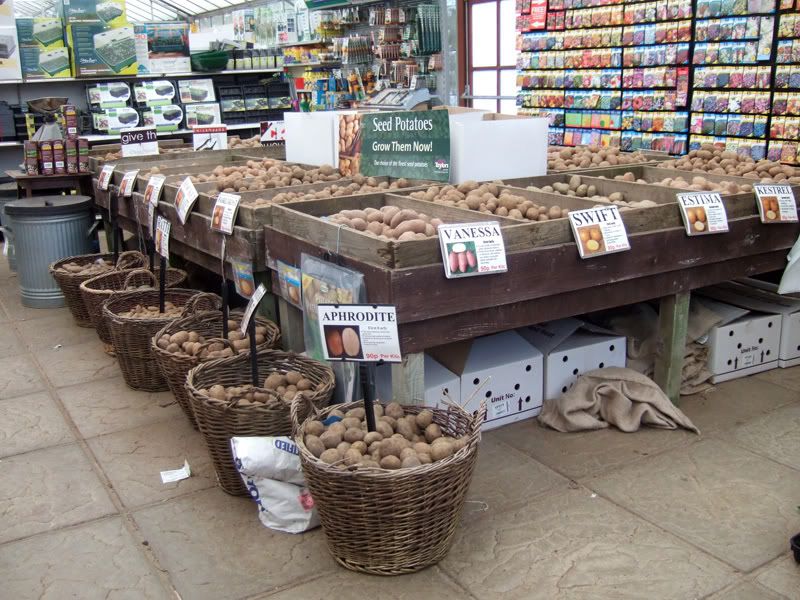
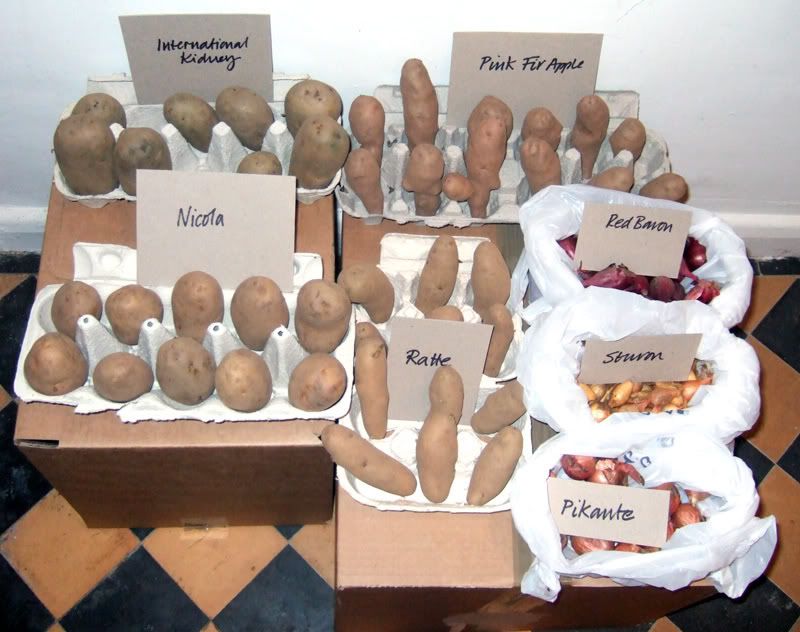
The last week of January is when I buy seed potatoes and I like to get them from a garden centre that has a good selection of varieties and allows you to buy small quantities. Daughter of the Soil posted the other day about buying seed potatoes from a small garden centre that had 111 varities of spud!!!!! Well, I can't top that, but I had a choice of 31 varieties at Oakington Garden Centre near Cambridge.
My chosen potatoes for The Year of the Potato are:
'International Kidney' - these are the same as 'Jersey Royals' but can't be called that because we're not on Jersey, they grow very well in our garden.
'Pink Fir Apple' - these knobbly pink spuds have a lovely waxy texture, they are late maturing and hopefully will produce a good crop of late summer salad potatoes 'Nicola' - I haven't tried these before, but selected them instead of 'Charlotte' just to see what they're like, they should have a waxy yellow flesh. 'Ratte' - also known as 'Asparges' these are the French gourmet potatoes, less knobbly than 'Pink Fir Apple' they are the choice of many top chefs.
. . . and here they are carefully placed in egg boxes, eyes upwards, in a cool light corner in the entrance hall to my studio, chitting. They will develop little shoots and will be ready for planting out at the end of March.
I also bought shallots and onion sets which were being sold loose so you could select as many as you fancy. I bought Onions, 'Red Baron' and 'Sturon' and Red Shallots 'Pikante'.
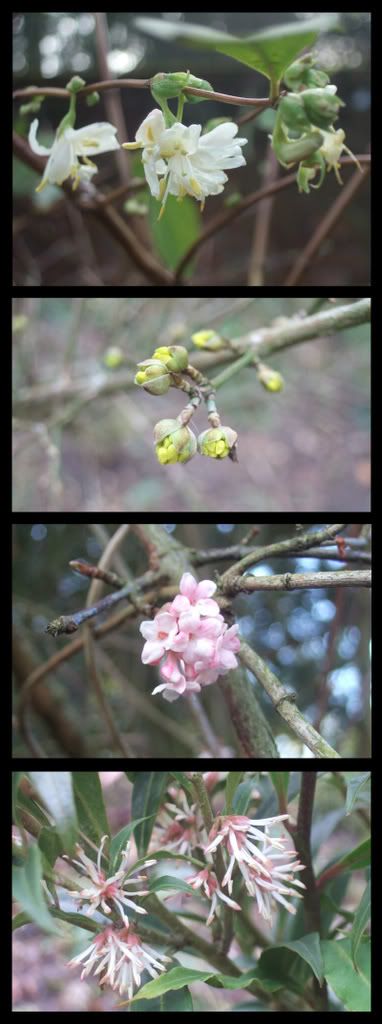
Delicate pastel blossoms on bare stems are a special winter treat. In summer there is a multitde of colour and scent, but in January a tiny pastel flower with a delicate perfume will attract attention – look! how beautiful!
Four flowering shrubs in my garden in January . . .
– fragrant cream flowers of the Shrubby Honeysuckle (Lonicera fragrantissima)
– breaking buds on the Cornelian Cherry (Cornus mas)
– clusters of richly scented sugar-almond pink flowers on the Viburnum (Viburnumx bodnantense'Dawn')
– exquisitely perfumed spiky flowers of the Christmas Box (Sarcococca humilis)
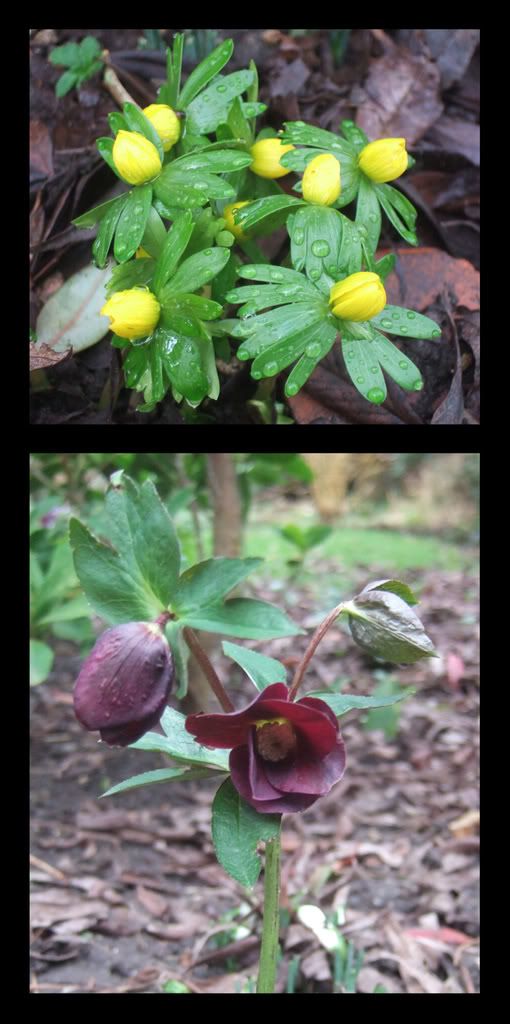
Bursting up through the soil and leaf litter are perfect freshly unfurled Winter Aconites (Eranthis hyemalis) . The deep burgundy red Hellebore is one of the many I grew from seed from a slate-purple Helleborus Orientalis, this is the second year they have flowered.
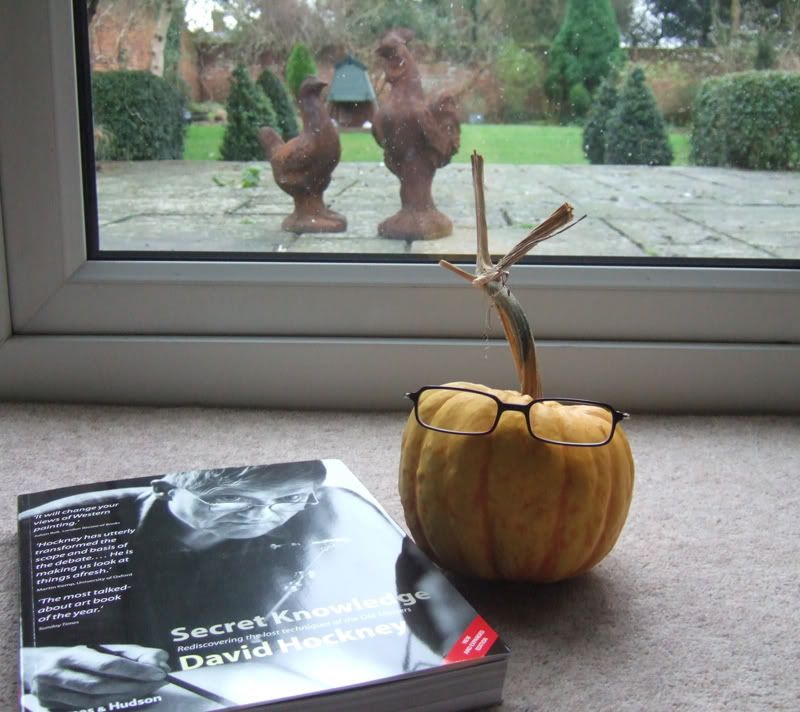
Yesterday I collected my new spectacles from the opticians – yes, I've been advised to wear specs for close work and reading. My designer specs are being modelled for you by one of my beautiful Winter Festival squash.
The book was my Christmas present from Cliff - 'Secret Knowledge' by David Hockney. There was so much controversy when David Hockney first published his ideas about how painters in the past probably made use of lenses and mirrors as an aid to making accurate "photographic" images, rather than purely "eyeballing" (Hockey's word) the subject. I think it makes a good deal of sense and it is so refreshing to look at paintings in the company of an artist rather than an academic art historian. The reproductions of paintings in this book are outstanding and Hockney's observations are down to earth and backed up by his own experiments in using the optical devices. This is a fascinating book.
You may have noticed a statuesque hen and cockerel through the window - these were another (surprise) Christmas present. The under-gardeners were slightly nervous of them at first, but they now know the new-comers aren't competitors for the food so completely ignore them!
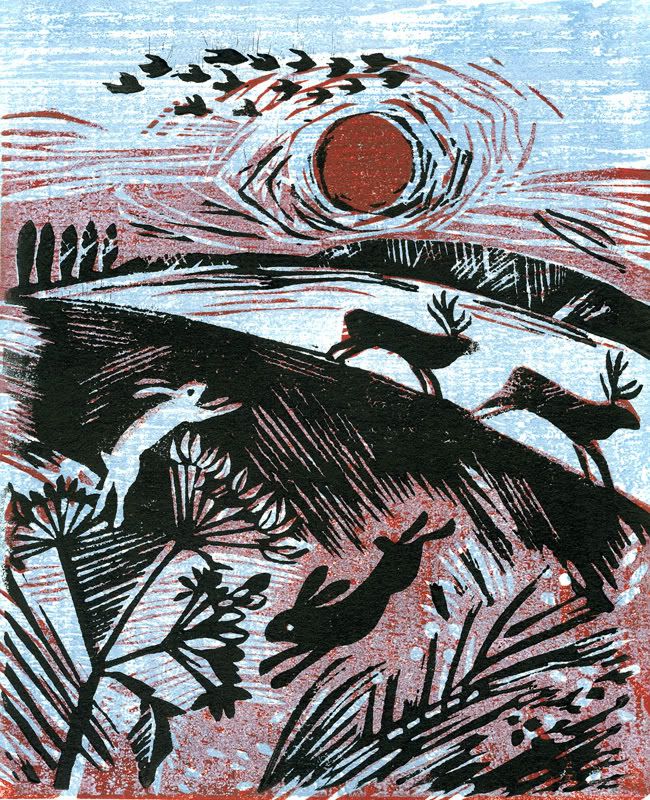
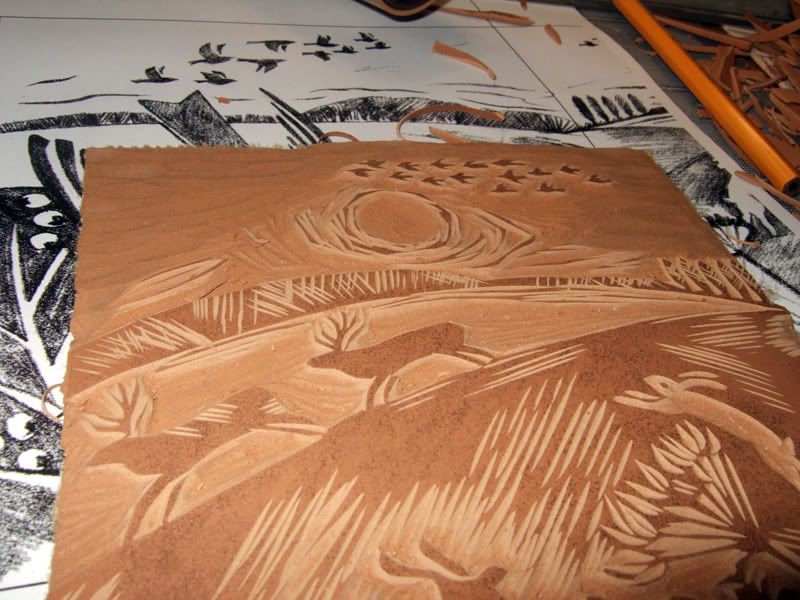
Layers are very useful when working on digital illustrations, and printmaking with multiple blocks is a very similar concept. So it is a natural step to use the "layers" in Photoshop when I am working out the design for another colour lino block for the Fieldfare/Running Deer print.
First I printed a proof of the black lino block and scanned it. I then "draw" the red block design over the top on a separate "layer" which is slightly transparent so that I can see the black design underneath. The next step is to print out the red block design, transfer it to the lino block and cut the design.
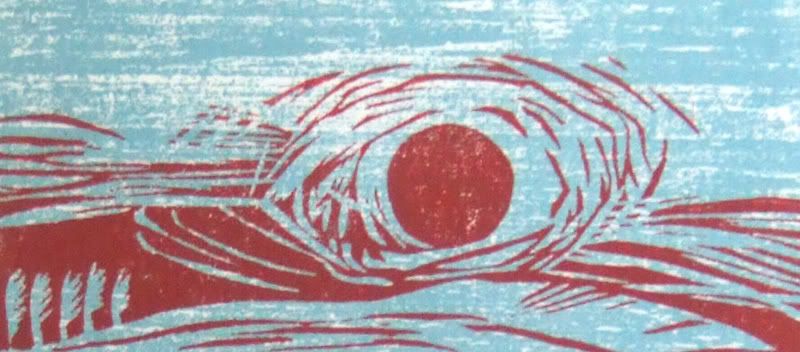
This is a detail of the 'Running Deer' red block printed over the pale blue oak wood block print . . .
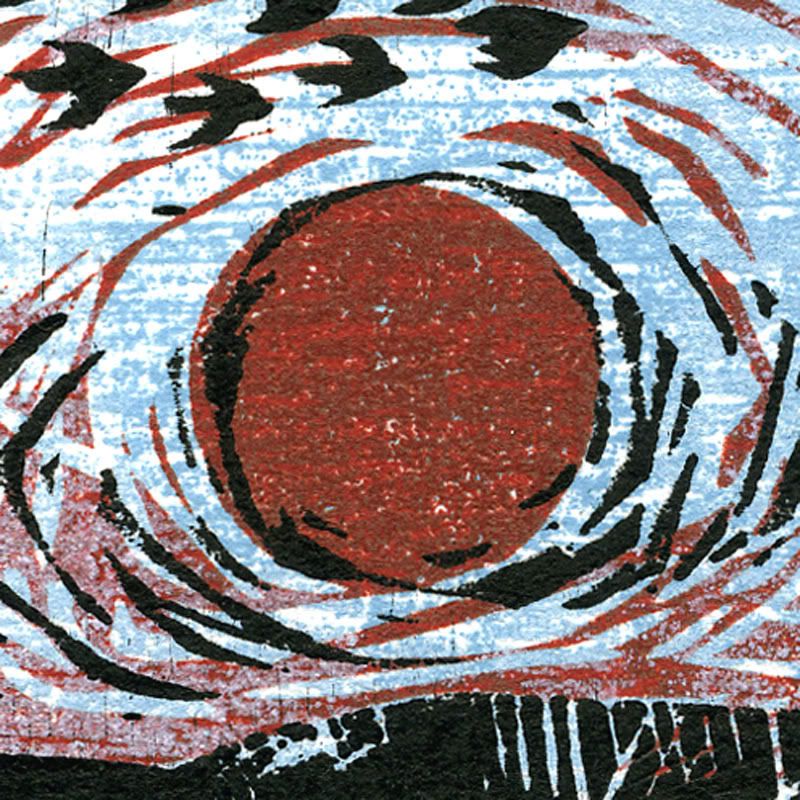
I decided to soften the red and blue by over printing with a third layer of colour – the oak block this time inked with translucent pale grey. I masked the area over the sun so that it remained a strong red. When this layer was dry I could overprint with the black lino block. Of course not all the imprressions work out, and I was experimenting with the transparency of the ink and the pressure needed on the barren, but I had a three good prints of both 'The Arrival of Fieldfares' and 'Running Deer'.
I needed one image that represents the direction of my work in 2008 to go next to my entry in the Cambridge Open Studios 2008 Guide Book, this is the one that I selected. July may seem a long way off, but on Sunday the starting whistle blew for Cambridge Open Studios artists to prepare for opening their studios to the public in the summer. A well-oiled admin process got into gear; artists gathered to fill in forms and talk of marketing and websites and sales and stuff; and the show got on the road!
Happy New Year! 2008 entered hiding behind a shroud of dense fog, but that didn't deter us from taking a bracing walk with friends before enjoying a feast-like lunch! There were no glorious views but the landscape fading into a grey-white middle-distance had a strange presence. Water, air and earth merging - an image to return to later.
In my mind I have a 'file' of saved images for future prints and paintings. While I'm busy working on other things or out for a walk or gardening I 'look' through the images and they seem to come into sharper focus. When I eventually put them onto paper the scene seems to draw itself, I've walked around the scene in my mind and everything about it is familiar.
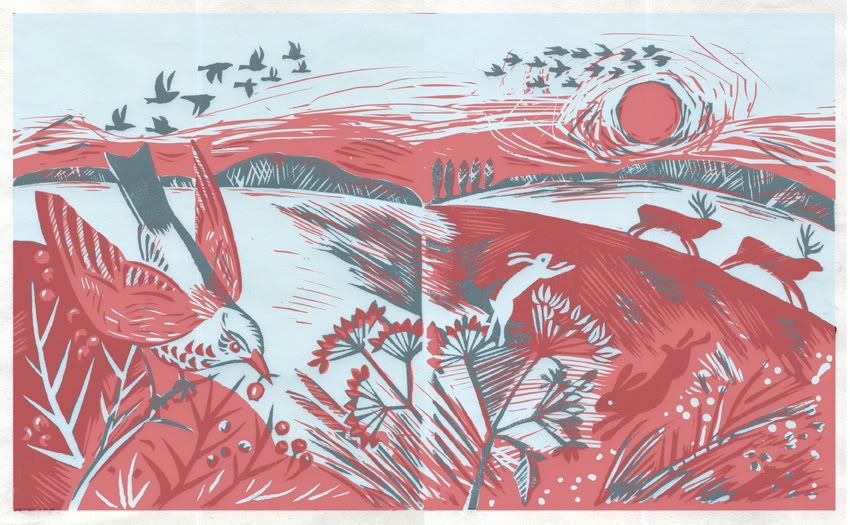
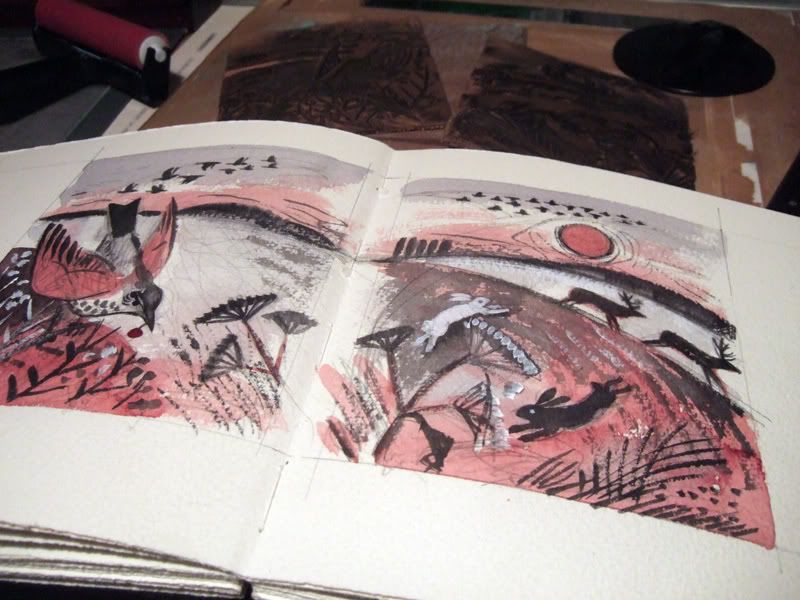
This is the sketch for a pair of prints "The Arrival of Fieldfares" and "Running Deer". It has come together from a collection of fleeting moments, there and then gone images seen from a footpath or from the car. All are special moments.
A flock of chattering fieldfares arriving from the cold north; a single fieldfare plucking a haw from the hedge before rising into the air to join the flock; two deer racing along the crest of a field; the copper-red sun sinking behind distant woods; skeletal hogweed seedheads; hares racing across ploughed furrows.
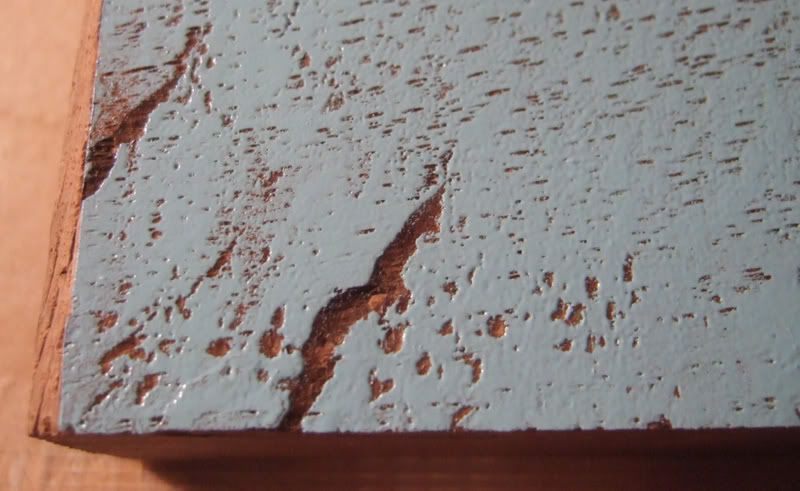
The lino blocks will be printed over impressions taken from a pair of oak blocks - the grain continuing across the pair of prints. I love the way the grain is visible in the backrounds of japanese woodcuts and want to use the wood grain of the English oak to give a texture to the sky and land.
I love to read your comments (except for spam and advertising which I will delete) and I'll reply under your comment whenever I can, but I may miss some if I'm busy.
My Website
My Online Shop
Support indie creatives
even a small purchase from an indie shop or maker makes a difference