Celia Hart's blog about what's going on in and around her studio.
Art, printmaking, inspirations, gardening, vegetables, hens, landscapes, wild flowers, East Anglia, adventure, travel.

Showing posts with label fruit. Show all posts

Wednesday, 10 September 2014

An abundance of pears!


 Freshly picked pears in a bowl we bought from David McDowell who made us promise to use it in our kitchen.

A few years ago . . . I think 4, maybe 5? . . . I decided our garden wall needed a pear tree. I did some research and decided to buy a bear-rooted one from Ken Muir, we drove down to the nursery in Essex and selected a 'Beurre Hardy' pear suitable for training as an espalier against a wall.


I'm ashamed to say I neglected to train in correctly in its early years, but I've tried to get it under control and it sort of looks 'trained' in a relaxed sort of way.

Up until this year the most pears its had is 6. This year there are far too many to count! We have an abundance of pears!


Pear - 'Beurre Hardy'

Pears have been cultivated for centuries, but it was in France that juicy, butter-soft, dessert pears were bred in the 17th and 18th centuries. 'Beurre Hardy' originates from around 1820 in Boulogne and is named after M. Hardy who was the Director of Aboriculture at the Jardin du Luxembourg in Paris. In the US you may know it as the 'French Butter Pear'.


The fruit need to be picked in mid-September, just before they ripen. If allowed to mature on the tree the flesh spoils and becomes brown and grainy; but harvested while they are still firm and carefully stored for a few weeks in a cool place, they will become juicy and sweet, with the texture of butter!


I can't wait!


Mmmm! Pear and frangipane tart, with blue cheese and walnuts, ice cream . . .

or eaten in the garden with juice dribbling down your chin!

what's your favourite pear recipe?

Celiaxx

Sunday, 21 July 2013

Nice ices for a heatwave

It's hard to believe that a few weeks back the gardeners among us were bemoaning the long long long winter and longing for some sun to warm the soil. Then in a flash Spring came and here we are past midsummer and in the hottest of heatwaves for, well, ages!!! I know some of you live in places where 30C is a pleasant warm day, but here in the UK we go through a giddy happy phase, then get pink and sweaty and a tad stressed, then we can't sleep (because we don't have fans and air-con and stuff like that) and then the government issues a health warning and we worry we all might die.

Anyhow, back to the plot . . . the soft fruit plot to be precise;  our currants have loved the soaking they got last year followed by a good old fashioned snowy winter, so that when the warm weather came they blossomed and the recent heat ripened the fruits that hang like strings of pearls, rubies and jet beads in the bushes.

I had protected the White Versailles Currants from the birds with a wire mesh cage . . . there is just one bush - it's fruits are precious.


We have many Red Currant bushes, an unknown variety that was in the garden when we moved here; I planted the prunings and they all grew! This year we didn't net them, the larder is still stacked with jars of red currant jelly from last year, so I was happy to share them with the local Blackbirds.


The Black Currants are another unknown variety that came with the garden and my enthusiastic growing from cuttings! The berries are HUGE! The Blackbirds prefer the Red Currants, so there is no need to net them.

On Saturday afternoon I spent a few happy hours picking currants while listening to TMS on my iPhone headphones via wifi. I had found the perfect recipe for some of our currants on Fenland Lottie's blog – Frozen Fruit Yogurt :-)

First I had to clean and de-stalk the currants, cook and purée them – three times for the three separate colours (this took a lot longer than I thought!). I don't have an ice-cream maker, but neither did Fenland Lottie (her's had broken) so as the three tubs of mixture started to freeze I had to take them out of the freezer and beat them. Then I realized the White and Red Currant ices were way too tart (mouth puckeringly so!) so I tipped them into mixing bowls, added honey and beat them thoroughly before re-freezing.

It all took a long long time.

And a lot of energy . . . my energy – I worked hard for these ices!

Tonight we tasted them – they were worth all the effort!


And when the thermometer soars again tomorrow I know how I can cool off ;-)

Celia
xx


Monday, 2 July 2012

Philosophical gardening and strange fruit

I really feel sorry for anyone who has started to 'grow their own' this year or last; you haven't had it easy, it's either been too dry, too hot, too cold or too darn wet. It's easy to moan about what hasn't grown and get very down and fed up about trying to be self-sufficient in fresh fruit and veg.

The thing is, there never is a year when everything grows and produces a wonderful crop, so it's best to grow a variety of the different crops and there's bound to be a few that do quite well. There will probably be one or two that surpass all expectations. You could call it Biodiversity, I'm going to call it Philosophical Gardening.

Here's an example . . . Gooseberries.

Some years, well actually most years, they are a bit tricky to get to crop well. If it's warm and a little bit humid the bushes get mildew and the fruit get covered in a horrid fungal bloom. Then, as if that isn't bad enough, the leaves suddenly disappear! Munched, seemingly overnight, by a marching army of Gooseberry Sawfly larvae.

This year (while we've all been hiding indoors, keeping warm and sheltering from the storms) our 'Invicta' Gooseberry bush has been flourishing, growing big spiny new shoots, lush shiny green leaves and lots and lots of fruit. Untroubled by mildew and wriggly maggots, the fruit have swelled and the branches hung down under the weight of hundreds of plump green bristly berries.


On Saturday afternoon I decided to pick all the Gooseberries from our single bush, the yield was 2.5 kilos! I sat in the shade and while listened to the Wimbledon commentary on TuneIn Radio on my iPhone, I nubbed the Gooseberries.


Spending all that time looking at Gooseberries, made me realise what strange little fruits they are. What was the flower stalk is that thin olive-green stem ending in a tiny trumpet shape; the fruit bit is like a green balloon, the remains of the dry shriveled petals are still attached to the end opposite the stalk.

I put one half of the Gooseberries in the freezer and with the other I made Gooseberry and Elderflower jam (River Cottage recipe as shown here). It smelled gorgeously flowery as it cooked.


I put a dozen Gooseberries aside to be 'life models' . . . I wanted to record how Gooseberries, which you'd think are as similar as peas in a pod, are actually each unique.  I remembered what one of my art college drawing tutors used to say as he paced behind us during life classes, "first, the strange shapes; the strange shapes".


At the end of the day there were five jars (and a bit over for Sunday breakfast) of beautiful, complex, sharp, sweet, Gooseberry and Elderflower jam. A jam of such distinction really deserves some scones and clotted cream!


And here are the strange fruits . . . each one a little different from the others.


Celia
x


Saturday, 18 February 2012

On being a tour guide for the day

Did you guess who Friday's visitor to PPP-HQ was? 

Here are some more clues . .  .

The Very Important Garden Blogger is passionate about vegetables

'Does not do flowers' (you must know by now!)

And has a naughty sense of humour . . .  Oooooo Matron!


Yes, it was indeed Matron of Down on the Allotment who arrived on my doorstep not long after breakfast on Friday morning. After a cuppa and a chat (about veg seeds) Matron joined me to tidy up the hen house and collect the eggs; then we had a tour of my plot – I'll let Matron tell you more about that.


We then jumped in to the 'tardis' and took a scenic route through 'hare country' to Saffron Walden and Audley End House. Matron wanted to see the walled vegetable garden, a showcase for Garden Organic's Heritage vegetables and fruit. The greenhouses are under wraps for repair and there were few vegetables to be seen, but with no leaves to cover the branches the expertly trained and pruned fruit trees and brushes were works of horticultural art.

 My particular favourites were the criss-cross living trellis of old apple varieties.

And the fan-trained pear trees along the high garden wall.


After a quick look in the stables, we were in need of a warming lunch – we headed straight for the Housekeeper's Room for big bowls of broccoli and stilton soup.

We were lucky that our visit coincided with a re-enactment day in the Service Wing.

 There was laundry hanging up to dry . . .

The Dairy Maid was shaping freshly churned butter into pats and pressing them with beautifully carved moulds . . .

And in the kitchen "Everything but the squeak" of a pig was being made into pies, brawns, roasts and jellied stock; presented just as it would have been in the 1880s.


Later in the afternoon we drove to Cambridge; it was fun being a "tourist in my own town" as I waited on Garret Hostel Lane Bridge for Matron to take the iconic tourist shots of the river and bridges and punts.


Along The Backs another iconic Cambridge view is changing . . . trees were being felled behind King's College. But before you throw up your hand in horror, it's all part of a grand plan called The Backs Landscape Strategy, if you follow the link and download The Backs Landscape Report, you'll find a fascinating history of how the land beside the river behind the central Cambridge colleges has evolved over the centuries. Many great landscape architects produced plans and ideas of how it should change, some plans were implemented others weren't. Cambridge University is 900 years old and it sees time in bigger chunks than the life-span of one generation.


You may be surprised to learn that the primary reason for Matron's visit wasn't vegetables, or dogs, but to hear King's College Choir sing in the Chapel – Matron is also passionate about music and in particular choral music.

Not many people realise that anyone can go to Choral Evensong in King's College Chapel, it takes place on most days during the university term times and it cost nothing! You just have to turn up about 15 minutes before the service and join the queue at the door.


Once inside, we took our seats just a few feet from the choir stalls; the light was fading outside and as it did the colours of the huge stained glass windows softened and dissolved into blackness leaving the chapel lit by dozens of candles. The choir quietly processed through the archway under the organ screen and took their places . . . then the service began. We, the congregation, each had our laminated service cards with very precise instructions when to stand, sit, kneel, turn to face the altar. It was a well rehearsed operation – they've done it many times before – just for a few centuries.

Our eyes became accustomed to the darkness so we could see the lacy fan vaulting high above and the choristers' faces as they concentrated hard on following the music . . . 'Erkenne mich, mein Hüter' by Bach; the responses set by Byrd; Psalms 86 set by Atkins and 88 by Colborne; the Magnificat and the Nunc dimittis again by Byrd; and finally the anthem 'In the midst of life' by Purcell.

It was sublime! It was like a meditation, so relaxing and uplifting. Where else can you just walk in for free and hear a 45 minutes of the best choral music in the world!? Just marvelous!

So, how do you follow that then? We met Cliff in The Eagle, one of the oldest of Cambridge's many pubs – frequented in the past by RAF pilots in WWII and Watson and Crick when they were mulling over the structure of DNA; and had a drink before walking around the corner to Fitzbillies for supper . . . which definitely didn't disappoint!


Celia, with thanks to Matron for an excuse for a great day.
x

Tuesday, 28 September 2010

Season's end


In the past week it seems like someone clicked a switch and turned on Autumn – there's a chill in the air and damp, dewy, mistiness hangs over the garden reminding us that we live in a valley where cool air nestles until midday.

I haven't blogged much about the garden this year, mainly it's because we've been busy with life and family stuff that has to dealt with come what may – consequently the garden has had to fend for itself. I have had a little time in the past month to do this . . .

. . . a new long narrow border planted with bearded iris, red-hot pokers and alliums.

Elsewhere the garden had descended into a wild chaos – this is the Dragonfly Pond, the shallow pond dried up completely in the nine week drought but it is now full and has joined up with the deep pond through the narrow dividing channel.


For hedgehogs that come into the garden for a drink (yes I know they do because they leave black droppings shiny with beetle wing cases on the lawn) I have renovated the Hedgehog Cave in the corner behind the pond. I wonder if they've checked it out yet?


At last the little plants in the big blue pot are flowering and make a pretty miniature garden.


Through the green door in the wall the vegetable garden looks as ramshackle as the wildlife corner! Despite the obvious crop failures . . . the three-sisters mound and the runner bean arch . . . . there have been and still are plenty of crops to harvest.


I have masses of herbs! I think it's one of my favourite things – to walk out to the garden and pick herbs to use fresh in the kitchen. Clockwise from top left, here is my (self-sown!) Italian flat-leaved parsley patch; a second flush of gorgeous Moroccan mint; sage which is perfect with winter veg and pork dishes; and Old English thyme – I think thyme is my new favourite herb, it's such a deep complex flavour.


The Rondo grape vine is looking very autumnal. We need to pick those grapes – they taste lovely but are full of big pips! We're not into wine making so we'll probably just drink the fresh grape juice. The hens love them (and the pips too) so if we don't eat them they get recycled into eggs!


This a first for our garden . . . Achocha.


The leaves look a bit like a herbal substance we could get arrested for growing, in fact it's one of the traditional food crops of the Incas from South America, a 'slipper gourd' . . . the little green fruits develop in the leaf axils. We tried a few chopped and added to cous-cous to accompany a tagine, they have a pleasant crunch and taste a bit like raw green sweet peppers.


The old Cox's apple tree has surprised us this year by producing some beautiful apples, the flavour is wonderful!


Bird's Egg climbing beans, from the Heritage Seed library, have been the one successful bean this year. I've left a few pods to ripen on the plant – worth it for that wonderful colour!


More splashes of colour from the rainbow chard leaves. I wouldn't be without chard in the vegetable garden, it survives whatever and eventually rewards you with a good crop! And it's so useful – I add the leaves and stalks to curries, casseroles, risottos, frittatas . . .


A stray self-sown leek seed-head – as attractive as those border alliums – it's sometimes worth leaving the garden to do it's own thing.


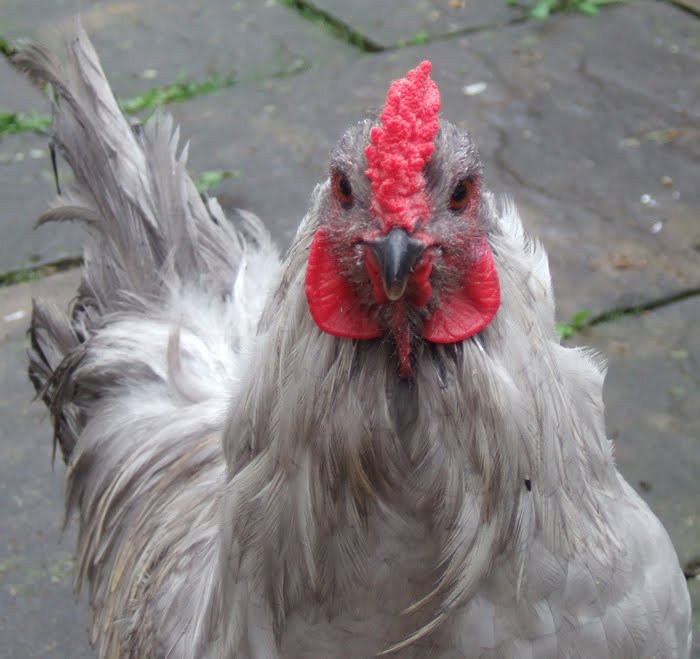
So, that's the end of the autumn garden tour, I'll sign off with this photo of Tarragon the Lavender Araucana cockerel. He's lived with us for nine months now and I'm getting used to the fact that the hens are 'his ladies' and not 'my girls'. Tarragon is moulting, he's covered with new quills just unfurling and he's growing a beard and moustache! His designer-stubble looks quite rakish!


I've a diary packed with exciting things to do and places to go to, so I think I need to take a short 'blogging break', I'll be back sometime in October and I'll tell you more about my plans for these ******mas events.

Tuesday, 10 August 2010

Figs!

Yet again fruit outshines our vegetables this year . . . after the Strawberries; Gooseberries; White, Red and Black Currants it's now the turn of the Figs.

To be absolutely precise a Fig is not a fruit, it is a flower – the flower is inside-out, it flowers within the fleshy pouch and there's a teeny little hole in the end just big enough for a Fig Wasp to crawl to pollinate it. Isn't nature amazing?!

A few years ago, and we've forgotten to make a note of the year, we picked so many Figs from our tree that we had to eat Figs for breakfast and lunch and have Fig Tarte Tatin for supper. I have a vague recollection it was a hot summer after a particularly cold winter, so when the recent winter of 2009/2010 was one of the coldest on record and temperatures began to soar in May, June and July we crossed our fingers and eagerly waited . . .


Sure enough this year we have figs, not in huge quantities but we have picked between 2 and 4 figs each day this week. You can just see our fig tree in the photo above, it's the spreading green tree in the distance in the corner of the walled garden. We didn't plant it – it's in the coolest and least sunny corner, which isn't the best position for a Mediterranean tree. But it's roots may be restricted as it is planted on a pile of rubble from demolished cold frames – and that's what the gardening books say is a good thing.

The most common Fig variety grown in Britain is the Brown Turkey, but from the size and colour of the fruit and the shape of the leaves I think our is a Brunswick. It's a waiting game, picked too early and flesh is dry and bitter, left too long it collapses into a mess covered with wasps!


Picking them isn't easy, it involves walking sticks and much stretching through the forest of giant leaves to bend down the springy branches and pluck the prize! Best eaten straight away, no need for cream, the fleash melts in the mouth and tastes like an exotic conserve . . . mmmmm!


We have a second tree in a sunnier spot between our house and the garden wall and next to a little outhouse. I grew this from a cutting – I was pruning the big Fig tree and noticed one of the low branches had 'layered' itself and was growing roots. I just stuck the branch in the ground and it grew – it's now as tall as the wall (3.5 m) and this year bears Figs for the first time.


In years when the Fig crop is small (some years we get only one or two) we can enjoy using the leaves . . . not as Adam and Eve a fancy dress costumes! but in the kitchen, use the leaves to wrap chicken or fish and bake in the oven. The leaves give off an exotic coconut flavour – just right for a summer supper in the garden.

Thursday, 15 July 2010

Cristening the apples


St. Swithin's day if thou dost rain

For forty days it will remain

St. Swithin's day if thou be fair
For forty days 'twill rain nae mair.


I've been wittering for weeks about the lack of rain . . . at last, early this morning, we've had a decent shower of rain, in fact it's still raining lightly and the garden is looking thankful for it. It's 15th July, St Swithin's Day – if you're well versed in English proverbs you'll know the rhyme and will have heard it at many a Sport's Day or Fete held on that day whether the heavens opened or the sun shone.

St Swithin is a home-grown saint, the bishop of Winchester in Saxon times. He was a local boy who obviously loved the people and villages in his care, he built churches for them and planted apple trees. When he died in 862, his last request was granted and he was buried outside, where his grave would be trodden on and rained upon.

One hundred and nine years later the monks of Winchester decided to move Bishop Swithin's body to a splendid shrine inside the cathedral – I wonder if they'd heard of the popularity of St Jame's shrine at Santiago de Compostela and wanted to be part of the new fashion for pilgrimage? The body was dug up on 15 July 971 and during the great re-internment ceremony there was a huge storm . . . and it continued raining for forty days and forty nights!

Poor St Swithin, taken out of his dear Wessex soil to be venerated in a glitzy reliquary – the story has a recent parallel told in Gerontius, a moving play by Stephen Wyatt , it was broadcast on BBC Radio 4 last week with Derek Jacobi as Cardinal Newman. Newman died in 1890 and, at his request, was buried with his close friend in a quiet graveyard near the place in which they had lived and worked; but as plans for his beatification gathered pace the grave was opened in 2008 to move the body to a tomb befitting a saint. Except there were no remains – only compost broken down by the rich damp soil.

St Swithin's symbols are apples and raindrops,
they are beautifully depicted here in a stained glass window
at St Swithin's church in Frettenham, Norfolk.
(Photograph © Mike Dixon, Norfolk Stained Glass
who kindly allowed me to use it here)


If it rains on 15 July, St Swithin
is christening the apples.

My garden is thankful on this damp, breezy
and cool summer morning.

Sunday, 11 July 2010

Jewels, beads and crystal cups

No sign of rain yet in our corner of south-west Suffolk, our garden is crisp and parched – the shallow Dragonfly Pond has completely dried up and I admit to neglecting most of my vegetable garden. But the big bonus this year has been the fruit crops . . . after a superb crop of Invicta Gooseberries which I made into jam, this weekend we harvested the Red Currants. There was one elderly, un-named Red Currant bush in the garden when we moved here, I gave it a good pruning and struck new plants from all the twigs (easy, I just stuffed them into the ground) – we now have a row of lovely young Red Currant bushes along the red-brick garden wall. We protected the currants from the hungry birds with nets and so our harvest this year was a good one.

So what did I do with two big bowls full of Red Currants? Make Red Currant jelly of course! Cold dark winter days wouldn't be the same without Red Currant jelly to accompany a hearty lamb casserole; and what's more satisfying than a beautiful row of glowing ruby red jars!


We used to have a dessert Gooseberry bush, Whinham's Industry – a celebrated variety from Morpeth in Nothumberland. Sadly, it turned up it toes one winter and is no more. I replaced it, in another location in the garden, with two fruit bushes: a modern red dessert Gooseberry Hinnomaki Red and a White Currant White Versailles. The bushes are still small and young, but we've been able to sample a small harvest of the delicious fruits.

This morning I picked this bowl of shiny creamy-golden currants . . .


and glorious plump red and lime green gooseberries . . .


. . . what could I do with these precious beads? Should I take them to the skilled Mrs P for her to make into a beautiful necklace, perhaps? But that would mean missing out on the flavours – all those sharp, sweet-sour, musky, complex, taste-bud teasing flavours that appear in the descriptions on the back of bottles of Sauvignon Blanc (the label never says that the wine tastes of grapes).

I remembered that Fiona, The Cottage Smallholder, had recipes for fruit jelly on her blog – yes indeed! There was the perfect recipe for my classy fruits, Dessert Gooseberry and White Currant Jellies. I had all the ingredients, I just needed some suitable glasses to serve them in, Cliff suggested the whisky tumblers . . . perfect!


It was while I was happily spooning fruit and pouring the liquid, that Cliff explained he had bought the tumblers many years ago 'when he had money – before he had a wife'. "They cost you how much", I nearly dropped the jug of gooseberry juice!

Tonight we'll savour bejewelled jellies in crystal cups.