Celia Hart's blog about what's going on in and around her studio.
Art, printmaking, inspirations, gardening, vegetables, hens, landscapes, wild flowers, East Anglia, adventure, travel.

Sunday, 30 June 2013

The Three Sisters (plus support act) 2013 gig

Yesterday, with enthusiastic help from Cheep and the team of under-gardeners http://twitter.com/celiahart/status/350924596121333761/photo/1 I tidied up and filled the Three Sisters pit with compost from our two-year-old heap. The compost mound is now planted with this year's 'sisters' . . .

Beans: Runner Bean 'Black Salford' plus one plant of Climbing French Bean 'San Antonio' (the only one that I managed to germinate)

Corn: 'Rainbow Sweet Inca'

Squash: 'Black Futsu' x 2 and Marina di Chioggia x1


Interplanted with Sunflower 'Earthwalker' (because I needed somewhere to plant these and I don't trust Cheep not to peck them if they are planted in the new cut-flower bed).


This was posted directly from the vegetable garden by the magical means of wifi :-)
Celia
xx

Thursday, 27 June 2013

The 5th pea in the Pigeon Proof Pen is . . .

The Salmon-Flowered Pea

Isn't she pretty! Like a Thomas Hardy heroine in a cotton sun bonnet.

It's not a purple-podded pea, but it's a must-have decorative vegetable. If it wasn't for the pigeons, I'd grow this in the flower borders. 

It grows to about 1.5 metres and as it gets taller the main stems thicken and the top gets bushy.

Clusters of buds appear at the top of the plant.

 The flowers are smaller than the other pea flowers but because they are in clusters they make quite an impact; posies of white and salmon pink.

These will be followed by clusters of small pods containing tiny sweet-flavoured peas.


I'll compare the pods from all five pea varieties next month.

Celia
xx

Sunday, 23 June 2013

More pea portraits from the Pigeon Proof Pen

In the previous post I introduced you to the first two peas to flower in the Pigeon Proof Pen, now here are two more and as you can see in the following photo, they are very different from each other . . .


On the right is a shorter more compact group of pea plants, they are a new variety and have obviously been bred not require tall supports and it also looks as though it will have a large yield, it's named


Shiraz

I don't usually grow modern commercial varieties of pea, but Shiraz promises to be a purple-podded mangetout, which is the holy grail for pea breeders! Here is a review of Shiraz by plantsman Graham Rice. As you can see in the photo above, the  whole plant is much more compact than an old fashioned tall pea; the flowers curl over coyly and there are two or more flowers on each stem. The wine red splashes where the leaves join the stalk is a tell-tale sign that the pods will be purple, I can't wait to see if the pods really are the colour of red wine AND tender enough to eat as a mangetout.


The pea on the left couldn't be more different in character . . .

Tutankhamun

When I saw this offered in Heritage Seed Library catalogue a few years ago, I couldn't resist adding it to my pea collection even though it doesn't have purple pods. It made up for it by having an amazing provenance:

"Thought to be originally from the garden of Lord Carnarvon at Highclere Castle, Berkshire. Lord Carnarvon, along with Howard Carter, discovered the tomb of Tutankhamun in November 1922. Could this variety be a descendant of the peas allegedly taken from the tomb? A tall pea (150-180cm) that produces its white flowers followed by pods of sweet tasting peas at the top of the plants making them easy pick."

Well, it probably isn't a pea from King Tut's Tomb, but I discovered it's a beautiful pea to grow. Everything about it is big and robust – it towers over the Shiraz, it towers over me! and the leaves and tendrils are sturdy and huge. The flowers are pure white and are held elegantly on the end of long slightly arched stems, like art deco lanterns. I love growing Tutankhamun alongside my purple-poddeds, and he's already almost reaching the roof of the Pigeon Proof Pen!


The fifth pea variety in the Pigeon Proof Pen has yet to flower, but when it does I'll take some photos . . . and this one really is something different!

Celia
xx


Tuesday, 18 June 2013

Blooms in the Pigeon Proof Pen

At last! a post about Purple Podded Peas . . .

This morning two of the pea varieties growing flourishing in the Pigeon Proof Pen, have their first flowers . . . and what beauties they are! Proving that growing heritage peas is not just for the shelled peas, it's also about the beauty of the plant, the pods and the flowers.

Let me introduce you to . . .

Curruthers' Purple Podded


Well, just look at the deep colour of the wings! the intricate veining on the standards!
For me, not the most productive of peas (although that may have been down to pigeon attacks in the past) but supposedly one of the best purple-poddeds for flavour. I see Curruthers as a polite, elegantly attired, gentleman gardener. My seeds were originally from a swap with Rebsie, you can read her expert review of Curruthers here.


Robinson


I don't just grow peas with purple pods . . . Robinson is a green podded pea and my selection this year from the Heritage Seed Library. The donor of the seeds had acquired them from a Mr Robinson, who had got them from somewhere in Scotland. The HSL catalogue describes Robinson as being vigorous and a favourite amongst exhibitors for their long, slim, slightly curved pods produced over a long season. The peas are reputed to be "extraordinarily sweet" . . . I'm looking forward to tasting them and if I'm impressed I'll save seed to grow lots next year.

As you can see in the photo, its flowers are white with beautiful green shading and a very attractive shape . . . I think Mr Robinson is a very handsome chap indeed!


More reports for the Pigeon Proof Pen soon,
Celia
xx

Wednesday, 12 June 2013

The mystery egg

I have just checked the nest boxes in the henhouse, this tiny khaki dark speckled egg was in the very back corner of the nest, I moved it closer to the other Holly and Ivy's eggs for the photo so you can compare size and colour.
I wonder which hen laid it . . . If indeed it was one of the hens and not another bird using this as its nest box!

I'll wait to see which hens don't lay today . . . my guess is that it could possibly be Ginger-Spice's egg, she hasn't laid for many many months but often sits in the nest. She used to lay large blunt ended sage green coloured eggs. I wonder? What do you think?


PS: my friends at Linton Kitchen think it is a pheasants egg, because it is just like the ones they sell in their lovely shop! Gosh... could it be? Will she be back to lay more?

PPS: the egg is so small, I now think it it very unlikely to be a pheasant's egg... veering back to thinking Ginger-Spice laid a random tiny egg.

Monday, 10 June 2013

The shingle will hide the secrets


Very early on Saturday morning Cliff and I drove to the coast, although we live in Suffolk it's a 2 hour journey zig-zagging eastwards to the far edge of the county. Months back we had booked to go on a tour of Orford Ness, we'd never been before. We hadn't payed much attention to what we were signing up for . . . and that turned out to be THE tour for 20th century military history enthusiasts!

For most of the 20th Century (1913 to 1993 to be precise) the 16 kilometre long shingle spit that hugs the coast of Suffolk just south of Aldeburgh, was the top secret research site for everything from the first forays into air warfare, parachutes and aerial photography through to testing the aerodynamics of the UK's atomic bombs and at the height of the Cold War the huge array of aerials of 'Cobra Mist' secretly eavesdropped on the Soviet Block. If this is your thing, read more here.

Luckily for me the sign above no longer applied! It was a grey day and there was a cold wind blowing off the North Sea, I settled for taking photographs rather than sitting on the shingle freezing sketching.

Orford Ness is now owned by the National Trust, the shingle spit is a nature reserve of international importance . . . you may have seen it featured on the BBC Springwatch (watch Richard Taylor-Jones stunning film here start at 31mins in, available until Thursday 20 June 2013). I found the juxtaposition of the mysterious architecture and the encroaching shingle and plants, fascinating.


Inside the buildings, while our amazingly knowledgeable guide talked of boffins (and apparently the word was first ever used to describe one of the top researchers in these very buildings!) I searched out textures and geometric shapes in the decaying laboratories.


Glassless windows framed views across the vast expanse of shingle . . . much of it still out of bounds because of the danger of unexploded ordnance.


The next chapter in the story of Orford Ness will be about the plants and wildlife that are now the only inhabitants (apart from the day visitors that come across by boat from the mainland) and gradually they will hide the secrets for ever.


On the seaward side of the Ness stands a lighthouse  –


Trinity House have made the decision that in these days of satellite navigation, lighthouses are no longer required the light will be turned off in a few days time and it will be left to the mercy of the North Sea which is eating back the coast at a rate of 5 metres a year.


Eventually it will collapse onto the shingle and be smashed apart by the waves.


You can see more of my photos of Orford Ness here:
the buildings
the windows
the textures
the plants

I hope to go back to explore again soon... and hopefully see more of the birds and hares.

Celia
x

Friday, 31 May 2013

The Hen-wife's Tale


. . . Chanticleer Cheep stood high upon his toes, 
Stretching his neck, and both his eyes did close, 
And so did crow right loudly, for the nonce; 

And Russel Fox, he started up at once, 
And by the gorget grabbed our Chanticleer Cheep, 
Flung him on back, and toward the wood did steer . . .

This simple widow and her daughters two We
heard these hens cry and make so great ado, 
And out of doors they started on the run 

And saw the fox into the grove just gone, 
Bearing upon his back the cock away. 
And then they cried, "Alas, and weladay! 

Oh, oh, the fox!" and after him they ran.

This cock, which lay across the fox's back, 

In all his fear unto the fox did clack 
And say: "Sir, were I you, as I should be, 
Then would I say (as God may now help me!), 
'Turn back again, presumptuous peasants all! 
A very pestilence upon you fall! 
Now that I've gained here to this dark wood's side, 
In spite of you this cock shall here abide. 
I'll eat him, by my faith, and that anon!'" 

The fox replied: "In faith, it shall be done!" 

And as he spoke that word, all suddenly 
This cock broke from his mouth, full cleverly.


And that (with apologies to Geoffrey Chaucer) is more or less what happened on Monday evening when Cheep was grabbed by a fox and miraculously escaped with a scratch and rather less feathers than he had earlier in the day.


Unfortunately our relief at Cheep's miraculous escape from the jaws of death, turned to sadness when, on Wednesday, I discovered that Bryony was missing . . . presumed taken to be Russel Fox's supper.

Of the three new pullets we got last October, I think Bryony was my favourite. She was bossy and annoying (especially when she spent three weeks insisting she was broody!)

We will miss her, I think Cheep misses her, and this weekend for the last time we will enjoy her final beautiful dark brown egg.


Celia
xx


Friday, 24 May 2013

How do you select a holiday destination?

Do you visit the same holiday destination over an over again? Or, do you prefer to visit a different places? And how to you choose where to go?

Earlier this year Cliff and I saw a small exhibition at the Museum of Archaeology and Anthropology in Cambridge, it was about ancient carvings on rocks . . . some were 8000 years old! The exhibition PITOTI "explored the links between the world of archaeology and the world of film, digital humanities and computer vision". What was fascinating was the use of 3D printing to recreate the carving as models you could pick up and handle . . . something I'm sure will be much used in in museum displays in the future.

We found out the carvings are found in the Val Camonica, in Lombardy in northern Italy extending north from Lake Iseo (which is one of the Italian lakes near Como and Garda, but you probably haven't heard of it because it seems that the Italians want to keep it all to themselves!)

Last week we flew to Italy for a holiday, we stayed in Iseo and had a stunning view of Lake Iseo from our room. It was only a short walk to the railway station to catch a train up the valley to Capo di Ponte, the town nearest to a large number of the rock carvings.


I'd be lying if I said we joined the hundreds of other visitors to the Archaeological sights . . . in fact we may have been the only visitors that day! But there were some information boards and signs pointing the way up the hill outside the town.

We found a fenced off area with large boulders in a grassy area at the foot of a cliff . . . the boulders were covered with carvings!


Nearby we spotted a small museum full of photos and casts of most of the significant carvings; there were also some fascinating reconstructions of tools and cutting and carving methods. I think the person who showed us the exhibits was the museum founder, Dr Ausilio Priuli.

We were recommended to walk further up the hill to another park where there were many more carvings on the exposed rock faces.


Some carvings were easy to spot, others were subtle and indistinct; but it was a beautiful place and the rocks were surrounded by beautiful mountain wildflowers and trees.

The views were stunning!


We had a lovely relaxing week in Iseo – catching trains, boats and buses to explore the nearby towns and villages. I'd forgotten just how beautiful Italy is!

I bought vegetable seeds and had a pistachio ice-cream . . . that equals a perfect holiday for me!


Yes it rained at bit, but even the storms are picturesque when it's warm enough to sit outside with your shoes off!


Back home, I'm paddling madly to catch up with work. Fingers crossed the weather warms up this weekend so I can sow those vegetable seeds :-)

But right now I'm going to snuggle up on the sofa with a hot drink and a piece of Amaretto chocolate.

Ciao!
Celia xx

Sunday, 12 May 2013

Laughter really is a good tonic

On Saturday we went to Wembley . . . no, not to the Cup Final . . . the Arena, to see the Eddie Izzard gig 'Force Mageure'.

We had a great time (I ached a bit from laughing at the bit about dressage being useful for reversing a horse into a cupboard) and it makes quite a change to be in a massive arena full of thousands of people.


After the show we walked the short distance back to the hotel, had a beer and fell asleep . . . So much better than driving all the way back to Suffolk. This morning we decided to find somewhere to explore before heading home, so we went to Hampstead and after a lovely breakfast we went to Fenton House . . . and it turned out to be a wonderful surprise! I think it may be my idea of a perfect garden, because there were all the things I like most . . .

 a lovely lean-to greenhouse, 
lots of seats and lovely secret corners 


beautiful but simple topiary


an orchard with wild flowers in the grass under the trees


a walled veg plot with perfectly trained fruit trees


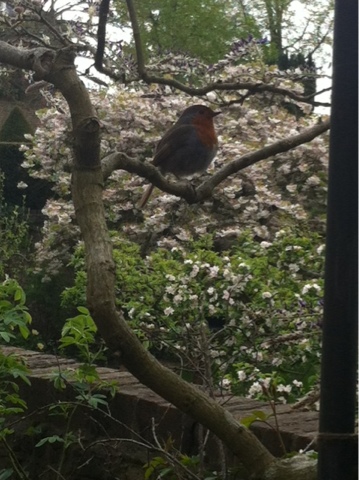
and a very tame robin


Who would have thought you could be in such a beautiful tranquil garden, but still see the sky scrapers of central London from 4th floor balcony?!


The rooms in Fenton House are full of the most delightful treasures . . . 18th century ceramics, embroideries of the most amazing detail and some lovely paintings. Everything was so charmingly displayed; I think I could happily spend a whole day in each room looking at all the things in detail.

I came away with my relaxed mind buzzing with ideas!

Celia
x

Saturday, 4 May 2013

PPP now means Pigeon Proof Pen

Hello! I've had an enforced break from blogging (reason: illusive cable snappage = no broadband) but I'm back and I'd like to welcome anyone who has found Purple Podded Peas via this lovely recommendation by that very nice chap Ryan in a rather good magazine called The Edible Garden (I'm not a huge reader of gardening mags, but this one is full of very interesting stuff).


So, what's all this about Purple Podded Peas? Regular visitors to my blog will know that I ramble on about all sorts of things, including our garden; but the peas haven't played a major role for the past couple of years mainly do to the ****ing pigeons. Now, I don't usually swear and I hardly ever cry, but the ****ing pigeons have made me do both over the past two or three growing seasons. I used to be able to grow tall wigwams of beautiful heritage peas with just a few pigeon-distraction measures in the early stages of growth. THEN (I can feel myself getting angry and upset just remembering this) the ****ing pigeons used nasty tactics; they waited until my peas were tall and covered with beautiful flowers and tiny pods and in a dawn raid they demolished the lot!

Something had to be done.
a) I could give up growing peas (I have saved seeds of over a dozen heritage varieties, most with purple pods) – that's not going to happen
b) I could buy an air gun, learn how to use it and live on pigeon breast terrine – I seriously considered this option
c) I could install a 'fruit cage' – previously ruled out due to huge expense

Earlier this year I noticed a tiny advert in a national newspaper: Henry Cowles - netting made in Britain since 1889, could they supply the solution at a price I could afford? . . . yes they could! AND what's more, the cage is made to measure so it perfectly fits over two of the raised beds in our vegetable garden :-)

The cage arrived . . . and it had to be constructed. Luckily I have a very tall person who was up to the task :-) 


The Pigeon Proof Pen (as it will now be called) has made me deliriously happy . . . for the price of one designer shoe my peas can grow, safe in the knowledge that the squadron of elite attack pigeons cannot harm them :-)


I start the peas in large deep pots in the greenhouse, when they are a few inches tall and with good roots, I plant then out around wigwams made of canes (home harvested form a giant miscanthus grass) and twiggy sticks (prunings from the garden shrubs)


One half of the Pigeon Proof Pen is now planted with five wigwams: Shiraz Purple Podded Mangetout, Tutankhamun, Curruther's Purple Podded, Robinson and Salmon Flowered.


The wigwams will be interplanted with various varieties of lettuce and brassicas.

Thanks to the Pigeon Proof Pen, the Purple Podded Peas have returned to the PPPs Blog!

Celia
xx

Sunday, 21 April 2013

April evening on the South Bank

After a morning working hard putting the netting on the "pea cage" (I'll tell you more of that another day) we drove down to London . . .

We walked past the shiny new Shard that slices into the sky (as you look at this, imagine the bells of Southark Cathedral pealing out in the background)


We strolled along the Jubilee Walk and past the bridges


We ate ice creams leaning on balcony of the Royal Festival Hall and watched the people below walking in the evening sunshine


We took our seats for the concert (Verdi's Requiem conducted by Daniele Gatti)


After the concert we looked at the twinkling lights on the river.

Friday, 19 April 2013

Primula Overture


Primula, its name tells us that it is 'the first', the first to flower in Spring; never has this been more true than than in this year's long awaited Spring. The icy wind from the North Sea was replaced by the warm South-Westerly and the Primroses in our garden rejoiced!

The Brimstone and Comma Butterflies danced over the carpet of Primroses and Violets, a few bees joined in too . . . I wonder what kind of been this is? I love its ginger fur.
btw Twitter has helped me ID this bee as a Common Carder Bumblebee, most likely a young Queen who had survived the winter and will now start a new colony . . . isn't that wonderful!


A few years ago I planted lots of Victorian Polyanthus that I'd grown from seed, these have hybridised with the wild Primroses, at first I thought of weeding out the coloured primroses but there are so many, so we let them mingle.


Last year I was visiting a local 'open garden' when I spotted two little Auricula plants that were left on a plant stall, so I bought them. When they flowered I discovered one pot had two different plants in it, so I carefully potted them up separately. I was now hooked, Auriculas have that effect on people. They are related to Primroses and Polyanthus, but they need a bit more tlc . . . never too hot and not too cold; not too dry but never too wet. If you treat them right they reward you with exquisite flowers . . . like this


I bought three more Auriclas this year, mine are 'just' Garden Auriculas, not the special named varieties, I could plant them in the garden but I think they look more special grown individually in old terracotta pots. I'll divide them to make more plants when this year's flowers have faded - and so I know which plant is which I've given them names. More photos of my small collection here on Pinterest.

Auriculas seem to be the flower of the moment, I wonder why? The history of Auriculas in England is closely linked to the Huguenot silk weavers and it is this story which is told in a beautiful collection of songs, the Auricula Suite I discovered this in a chance conversation with one of my customers - she is one of the musicians.
There is more about Auriculas and the Huguenots on the Spitalfield Life blog, including pictures of a rather lovely Auricula Theatre made from one of those wooden arbour seats that you see for sale in garden centres – now that's a clever idea!

Celia
xx